
History of Lake of the Ozarks Scout Reservation
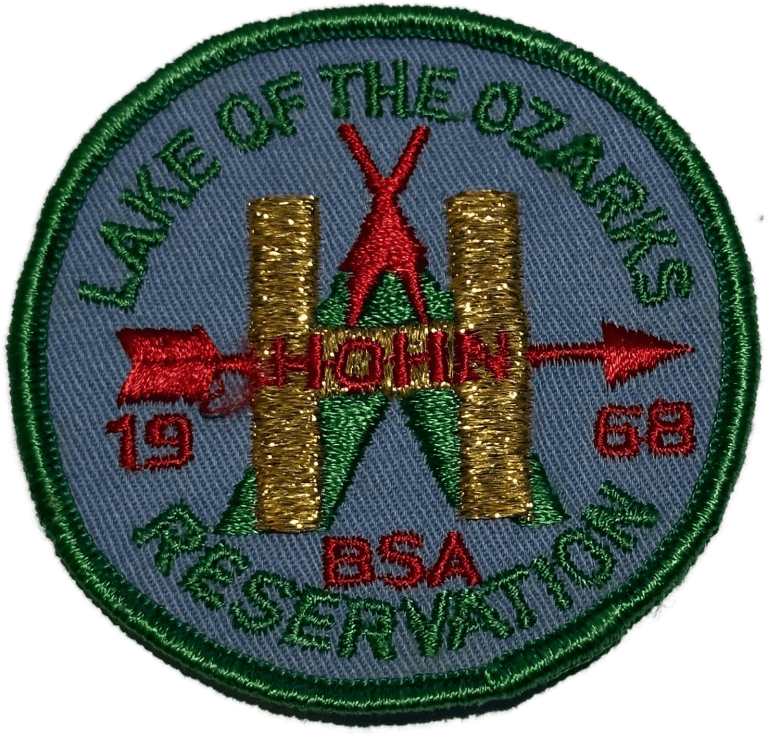
Editor’s note: Hohn Scout Reservation was officially renamed Lake of the Ozarks Scout Reservation on September 23, 2011.
How to Build a Boy Scout Reservation: From Chickens to Scouts
Origins (1960–1963)
The story begins in December 1960 when Missouri Highway Patrol Sergeant D.J. Selvin investigated a burglary at Dr. Roland Hohn’s property near Laurie, Missouri. During their conversation, Selvin learned that Hohn, a retired educator, wanted to convert his land into a “country chapel.” However, Selvin saw greater potential — he was active with Boy Scouts and the Lake of the Ozarks Council had been searching for a suitable youth activity area near Versailles and Laurie.
Dr. Hohn operated his original 319-acre property as a chicken farm. After discussions with Selvin and BSA Executive L.E. “Red” Moody, the property transfer materialized in March 1963, launching what would become Hohn Scout Reservation.

Initial Development (1963–1966)
When council members and scouts’ fathers toured the property, many thought the rocky terrain and steep lake drops unsuitable for younger scouts ages 11–14. However, scout advisors Charles Bailey and attorney John Inglish recognized the site’s potential for teaching outdoor skills like rappelling and tent-pitching to inexperienced urban youth.
The property met three council criteria established in 1955: minimum 300 acres, proximity to Lake of the Ozarks, and affordability. Scout executives Wiley Tracy, K.K. Johnson, and Bill Davidson championed the development.
The First Summer (June 1965)
The inaugural season featured overnight camps and weekends where scouts learned essential skills: building campfires with flint, pitching tents, hiking eight miles of perimeter trails, and attending Sunday worship services at the open-air Parkhurst Chapel, built by Richard and David Parkhurst.
Caretaker William Silvey established foundational rules that remain relevant today, including adult supervision requirements and the Scout Oath emphasis on duty, service, and moral character.
Rapid Expansion (1965–1966)
A December 2, 1965 development committee meeting at Sedalia’s Bothwell Hotel reorganized planning efforts. Committee assignments covered long-range planning, campsites, central facilities, land conservation, programming, and finances. Multiple community leaders contributed their expertise and resources:
- Major K.K. Johnson donated the Stephan Johnson Nature Lodge, named for his son
- E.W. Fischer, inventor of coin-slot pool tables, furnished materials for the Fischer Lodge administration and commissary buildings
- Richard Parkhurst and the Belchers provided the flagpole
- Claude Lambirth handled plumbing and water line installation
- Local contractors Roy Anderson and the Moore family (Les and Tom) provided ongoing construction support
By June 1, 1966, permanent facilities were completed: latrines, rifle range, swimming dock, 24 tents, refrigeration units, patrol stoves, and administrative infrastructure. That summer saw six weeks of activities hosting scouts from various troops and councils.
Growth and Evolution (1970s)
Facilities began showing age by the early 1970s. A planning group convened in Tipton including Ben Hainen, J.W. Proctor, D. Selvin, F. Jinkinson, and E. Rudder. They commissioned a 6,000-gallon water storage tank and a new administration building with updated facilities.
Bill Chapman of Versailles handled earth-moving work, while Buz Kuhl of Gravois Mills provided equipment for developing a playing field on the south entrance road.
Modern Programs (1980s)
A significant challenge emerged as older scouts, attracted to other interests, stopped attending camp. Scout leaders addressed this by acquiring the adjacent F. Joe DeLong property (90 acres) and establishing the C.O.P.E. program — Challenging Outdoor Physical Encounter — designed for scouts age 14 and older.
The C.O.P.E. course attracted corporate interest for leadership development and confidence-building training, earning national attention. This expansion increased council penetration throughout the Lake of the Ozarks region.

Legacy and Recognition
By the 1990s, the Great Rivers Council served 33 counties and achieved BSA Camp Excellence awards for five consecutive years — the highest national recognition for program quality. The council reported reaching approximately 25 percent of eligible boys between ages 6 and 16.
Success resulted from countless contributions, both significant and modest: Charlie Gillespie’s storage shed materials, Central Dairy’s refrigeration assistance, Dr. Henry Guhleman’s donated health lodge, and Buck Jones’ ongoing electrical support from Co Mo Electric.
The transformation from Dr. Hohn’s chicken farm to a thriving scout facility embodied the organization’s philosophy: “Friends begin here — so does citizenship.”
Key Dates
1960
Sgt. Selvin discovers potential of Dr. Hohn’s property
1963
Property transfer — Hohn Scout Reservation officially begins
1965
First Scouts arrive for overnight camps and weekends
1966
First full summer camp program — six weeks of activities
1980s
C.O.P.E. high adventure program established
2011
Renamed to Lake of the Ozarks Scout Reservation
2015
Dedication of the Welcome Center, Medical Lodge, and Pool. Ribbon cutting held for 50th summer camp season
2017
Invention Lab and Wood Shop were opened
2019
Blacksmithing and Welding Building built
2021
Guardians of Hohn formed
2023
Skilled Trades Building, Zipline built
2024
The Amphitheater and Trading Post were rebuilt
2026
Flag Plaza and Central Shower & Restroom built